Who is the world’s youngest judge?
Guinness World Records currently lists Henry Buckley as the youngest judge (male), based on his 2023 appointment as a Massachusetts Justice of the Peace at age 16. Guinness previously recognized me, Marc L. Griffin, following my 1974 appointment as an Indiana Justice of the Peace at age 17.
I dispute the reassignment because the two offices have different powers. My Indiana office involved hearing and deciding civil and criminal cases. An ordinary Massachusetts Justice of the Peace commission does not give its holder authority to hear and decide cases. Lawyers call that authority “adjudicative.” This site presents the historical documents, legal sources, and Guinness correspondence supporting my position that the reassignment does not satisfy Guinness’s stated definition of a judge.
I. My Record
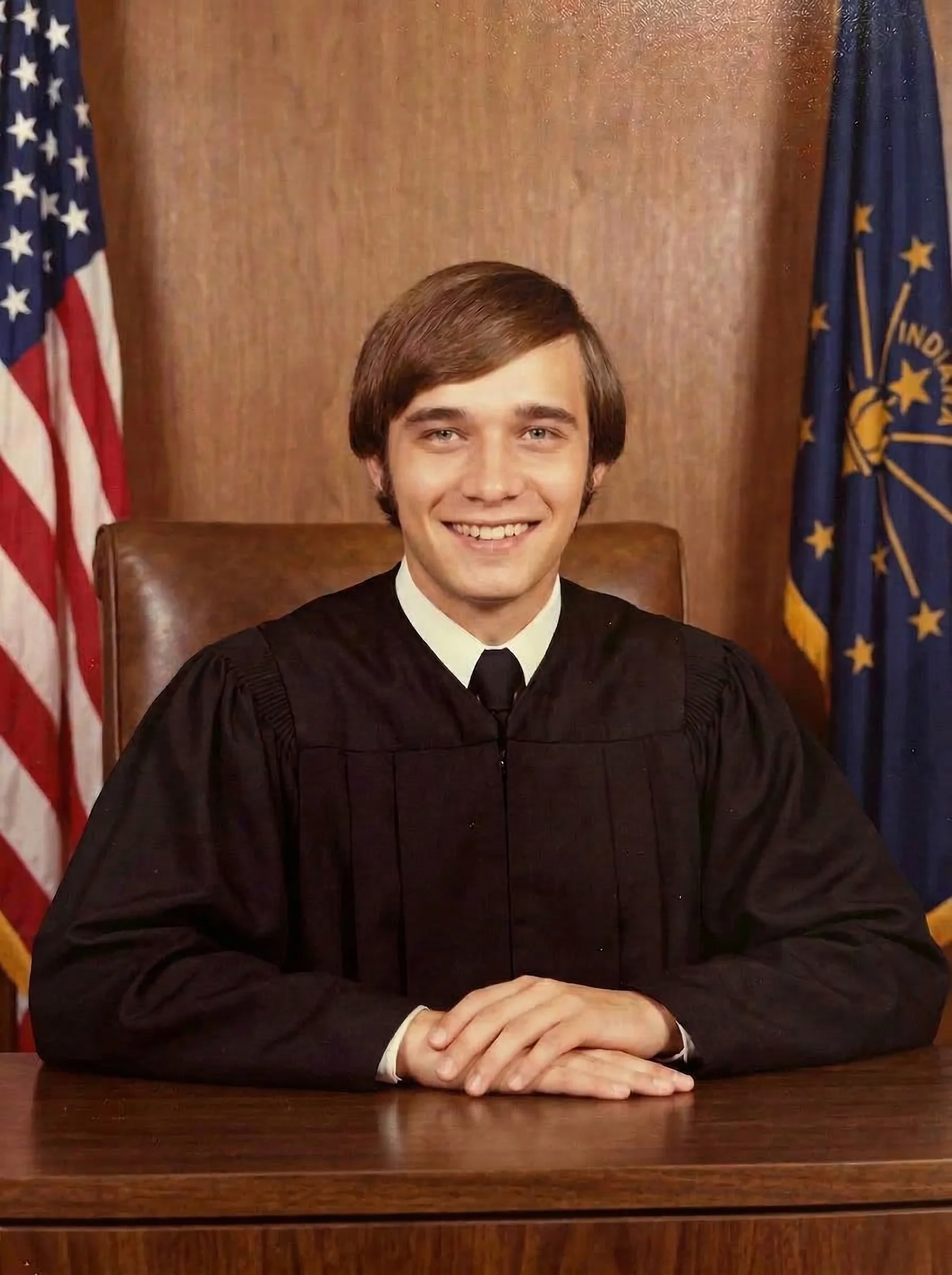
On February 19, 1974, Governor Otis Bowen commissioned me as Justice of the Peace for White River Township, Johnson County, Indiana. I was 17 years, 8 months, and 24 days old. I opened my courtroom in Greenwood, Indiana, on April 6, 1974.
At that time, an Indiana Justice of the Peace was a local trial judge. The office had authority over certain civil and criminal cases. In that role, I presided over cases in a court of law.
My cases included small claims, debt collection, bad checks, landlord-tenant disputes, property damage claims, and misdemeanors such as traffic violations, breach of the peace, shoplifting, and assault. I also conducted surety-of-the-peace hearings, issued peace bonds, and performed civil marriages.
What an Indiana Justice of the Peace Could Do
In that office, I carried out the core duties of a judge:
- Presiding over court proceedings
- Hearing witnesses and weighing evidence
- Judging the credibility of the parties
- Issuing rulings based on law
Guinness World Records Recognition
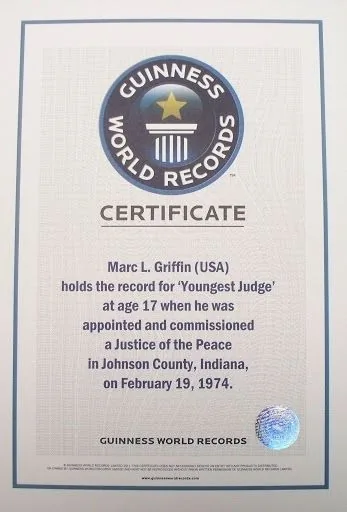
The American Bar Association also reported on the recognition. See Debra Cassens Weiss, Indiana Lawyer Who Started His Legal Career as a 17-Year-Old Judge Gets the World Record, ABA Journal (Oct. 31, 2011).
II. The Replacement Record
In June 2024, Guinness World Records named Henry Buckley of Hingham, Massachusetts, the “Youngest judge (male).” He became a Justice of the Peace at age 16 years and 3 days. He was appointed on August 23, 2023, and sworn in on October 19, 2023.
Archived copies of Guinness’s own record page show the timing. Wayback Machine captures from May 20, 2024 and May 30, 2024 still list me as the record holder, appointed February 19, 1974. The change came after that.
Soon after he took the oath, officials in Hingham protested his appointment. After an informal police inquiry and an attempted intervention by the Hingham Police Department, he resigned his commission on February 9, 2024.
At first glance, his record seems to break mine, because he was younger. But the real question is not age alone. It is whether the Massachusetts office he held was actually that of a judge.
III. The Legal Distinction
To answer that question, we have to look at what a Massachusetts Justice of the Peace can legally do.
An ordinary Massachusetts Justice of the Peace commission does not confer the powers of a trial-court judge. According to the Commonwealth of Massachusetts’ official summary of duties, a Justice of the Peace may:
- Perform marriages
- Take acknowledgments
- Administer oaths
- Take depositions
- Call certain meetings
Those are the principal ordinary duties identified in the Commonwealth’s published summary. A Massachusetts Justice of the Peace has no power to:
- Preside over court proceedings
- Hear witness testimony or weigh evidence as the adjudicator of a contested case
- Judge the credibility of the parties
- Issue rulings based on law
In short, the Massachusetts office does not include the authority to hear or decide cases. It is a different kind of office from the Indiana judgeship I held in 1974.
This matters because the title “Justice of the Peace” has never meant the same thing in every state. In some states, the office carries no court power. In Indiana, it carried real judicial power. As the Encyclopedia of Indianapolis records, Indiana’s Justices of the Peace had countywide authority over marriages, petty crimes, small civil cases, and traffic violations. So any comparison between record holders must look at the actual powers of the office, not the words in its title.
Mass.gov does describe a Justice of the Peace as a “judicial officer under Chapter III” of the Massachusetts Constitution. That label classifies the office. It does not add powers: none of the office’s listed duties includes the power to decide cases. See Massachusetts “Judicial Officer”: What the Label Means for the full analysis, and Massachusetts Justice of the Peace duties for each duty in detail.
IV. A Published Claim and the Governing Law
On May 30, 2025, Guinness World Records published a feature profile of Buckley by Katherine Gross, its U.S. editor. The article describes Buckley as elected, but his account in the same article describes appointment through gubernatorial nomination and Governor’s Council confirmation. In it, Buckley is also quoted as saying:
"Although I was never called upon to take bail or hear criminal complaints, it was within my purview."
The Governing Law
Under Massachusetts law, that statement does not match the legal powers of the office. The power to hear criminal complaints under Massachusetts General Laws, Chapter 218, Section 35A belongs to district court justices, associate justices, special justices, and clerk-magistrates. A Justice of the Peace is not on that list.
So the office he held gave him no legal power to hear criminal complaints. Guinness’s published profile repeated the statement without reconciling it with § 35A. That matters, because the legal powers of the office decide whether the record holder met Guinness’s own definition of a judge.
Guinness’s Own Description of the Office
The same article also describes what a Massachusetts Justice of the Peace does. It says office holders perform:
"duties like taking depositions, calling meetings, performing marriages (if authorized), and notarizing documents."
None of those duties involves hearing or deciding a case. Guinness’s own description of the office includes none of the functions in its definition of a judge (Section V).
After the record and profile were published, I was surprised to begin receiving emails, letters, and phone calls from people — including Massachusetts justices of the peace and lawyers — who had taken the trouble to track me down to say that no justice of the peace in Massachusetts is a judge. Their messages led me to study the issue closely and to write this article.
V. Guinness World Records’ Own Definition
I appealed to Guinness World Records. The organization declined to change the record. But its response revealed a serious inconsistency.
Guinness wrote:
"We have looked into the record requirements and holders, and concluded that no further action is to be taken, as all of the record holders provided the required evidence and met the record definition by being certified as 'Justice of the peace' by their local jurisdictions."
In the same message, Guinness gave its own definition of a judge:
"For the purpose of this record, a judge is a person who presides over court proceedings, either alone or as a part of a panel of judges. A judge hears all the witnesses and any other evidence presented by the barristers or solicitors of the case, assesses the credibility and arguments of the parties, and then issues a ruling in the case based on their interpretation of the law and their own personal judgment."
The Inconsistency
This definition describes what a judge does. It says nothing about titles. Yet Guinness’s appeal response treats certification as a “Justice of the Peace” as sufficient and does not explain whether or how it evaluated the office’s statutory powers.
Guinness World Records evaluates record claims across many legal systems. When the same title describes very different offices, getting the record right requires looking at the office’s actual legal powers — not just its name.
VI. A Practical Solution
There is a fair solution that takes nothing away from anyone. Guinness could move the Massachusetts achievement to a more accurate title, such as “Youngest Marriage Officiant” or “Youngest Justice of the Peace to Solemnize Marriages.” It could then restore my title as the youngest judge. That approach would preserve Henry Buckley’s accomplishment, reflect the real legal difference between the two offices, and correct the historical record.
VII. Conclusion
Guinness World Records calls itself “the global authority on all things record-breaking.” In this case, its record change conflicts with its own stated standard.
The issue is simple. Guinness defines a judge as someone who presides over court proceedings, hears witnesses and evidence, judges credibility, and issues rulings. I did those things as an Indiana Justice of the Peace. Henry Buckley did not, because the ordinary Massachusetts commission he held conferred no authority to do them.
Guinness can revisit a record approved in error. It can rescind a record or rethink the category. The question here is not whether someone younger held the title of Justice of the Peace. The question is whether that person met Guinness’s own published definition of a judge.
Anyone who relies on Guinness World Records as an authority should weigh these documented inconsistencies. A record book claiming global authority is only as credible as its willingness to correct clear mistakes.
The evidence on this page shows that the current record holder does not meet Guinness World Records’ own published definition of a judge.
Further Documentation
For readers who want the underlying evidence and primary sources, the materials below are grouped by topic.
Historical Evidence and Legal Analysis
Primary-source documentation of Marc Griffin’s appointment, and a state-by-state look at when a Justice of the Peace is a judge.
- Historical Record: Marc Griffin’s 1974 Appointment as the World’s Youngest Judge — An archive of 93 images: newspaper clippings, document scans, and artifacts. Some clippings reproduce the same wire-service story.
- Is a Justice of the Peace a Judge? Function vs. Title, by State — A legal explainer covering all 50 states, with the statutes that show when the office is judicial and when it is nonadjudicative.
Massachusetts Justice of the Peace Duties
The state’s official description of the limited, nonadjudicative duties of the JP office, plus companion explainers drawn from primary sources.
- Massachusetts Justice of the Peace Duties and Limits of Office — A walk-through of each listed duty, with citations to Massachusetts statutes and the state’s official duty summary.
- Massachusetts “Judicial Officer”: What the Label Means — Why the state’s constitutional classification of the office does not satisfy Guinness’s functional definition of a judge.
- Commonwealth of Massachusetts: Summary of Duties for a Justice of the Peace — The state’s official description of the office’s limited, nonadjudicative functions.
Guinness World Records: Policy, Verification, and Disputed Records
A companion analysis of Guinness’s own Review and Appeals Process, and independent reporting on the company’s verification standards.
- When Guinness Gets It Wrong: Titles vs. Function — What Guinness’s official Review and Appeals Process says it does, and what happens when a record is credibly challenged but not corrected.
- CBS News 60 Minutes: Guinness World Records — Independent reporting that raises broader questions about the organization’s verification standards.
Multimedia
- Audio Summary of This Article (YouTube) — An AI-generated audio discussion of the key points in this analysis.
Frequently Asked Questions
- Who is the world’s youngest judge?
-
Guinness World Records currently lists Henry Buckley as the youngest judge (male), based on his appointment as a Massachusetts justice of the peace at age 16 in 2023. My claim concerns whether that office meets the definition of a judge.
Merriam-Webster defines a judge as “a public official authorized to decide questions brought before a court.” Guinness’s definition, supplied in its response to my appeal, likewise describes someone who presides over court proceedings, hears evidence, assesses credibility and arguments, and issues rulings.
I was commissioned as an Indiana justice of the peace at age 17 in 1974 and exercised those judicial functions. Guinness recognized my record in 2011. A Massachusetts justice of the peace commission, by itself, does not confer authority to hear and decide contested cases. That difference in authority is the basis of my challenge to the current designation.
- Why is Guinness World Records’ youngest-judge record disputed?
- In 2024, Guinness said the record had been broken by a Massachusetts Justice of the Peace who had been appointed in 2023 at age 16. Under Massachusetts law, an ordinary Justice of the Peace commission confers no authority to preside over a court, hear criminal complaints, adjudicate contested cases, or issue judgments. Because Guinness defines a judge by function rather than title, the record change conflicts with Guinness’s own published definition.
- Has Guinness World Records made mistakes in assigning records?
- Yes. Guinness has changed, revised, or reassigned records when new information or stricter standards came to light. For example, Guinness revoked Bobi’s “oldest dog ever” title after a review found the dog’s date of birth had not been proven. Guinness also reclassified mountaineering records after adopting a stricter rule requiring climbers to reach the true summit of each peak. Guinness records are not always final. They depend on the evidence, the definition of the category, and whether Guinness applies its own standard consistently.
- What is the difference between a Justice of the Peace in Indiana and Massachusetts?
- In Indiana in 1974, a Justice of the Peace was a local trial judge with authority over civil and criminal cases. In Massachusetts, a Justice of the Peace holds a nonadjudicative office. Its powers are limited to performing marriages when designated, administering oaths, taking acknowledgments, taking depositions, and calling certain meetings. The Massachusetts justice of the peace office confers no authority to hear or decide cases.
- How could Guinness World Records correct the record?
- Guinness could move the Massachusetts achievement to a more accurate title, such as “Youngest Marriage Officiant,” and restore Marc L. Griffin’s earlier title as the youngest judge. That would preserve both accomplishments and reflect the real legal difference between the two offices.